
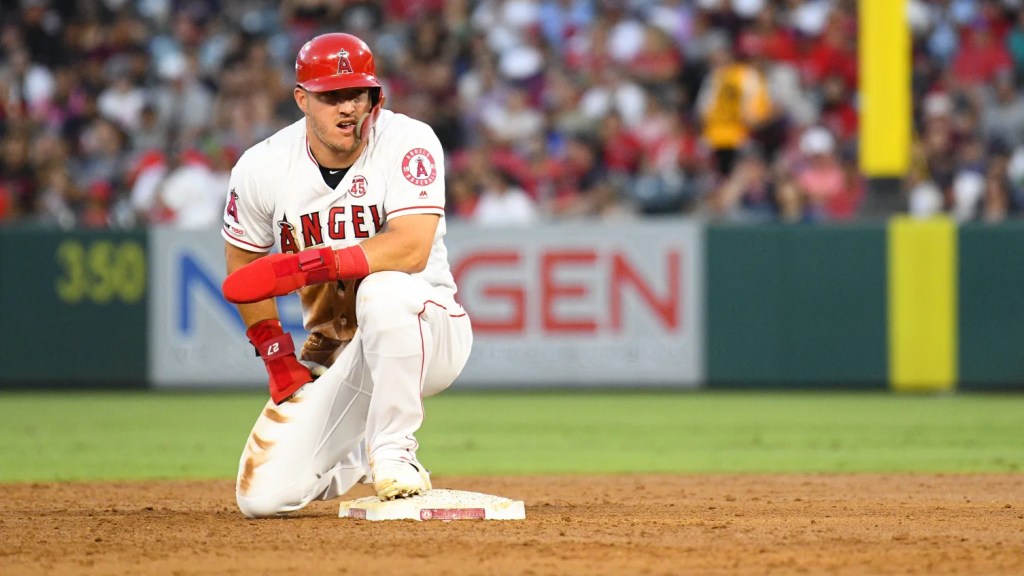
In a town built on stories, Mike Trout’s might be one of the best you can tell. Mike Trout is the best baseball player of his generation – you could argue that Trout is the best player ever. Yet, in his 13-year career, Mike Trout’s team, the Los Angeles Angels, have played in exactly three playoff games, all of which came during the 2014 postseason.
How? As of February of 2023, Lebron James, the best basketball player of this generation, has made the playoffs in 15 of his 20 professional seasons. Tom Brady, the NFL’s Mike Trout, made the playoffs in 20 of the 21 professional seasons he was the starter (the “miss” coming in a 9-7 campaign). Even Connor McDavid, Trout’s NHL contemporary, has made the playoffs in half of his professional seasons (and 4 of his last 6) despite being one of the worst teams in the NHL.
So we return to the question: How has Mike Trout continued to miss the playoffs? Well, the answer actually has nothing to do with Mike Trout. His team, the Angels, has been one of sport’s most poorly run franchises since his meteoric rise in 2011.
There are so many incredible things that can be said about Mike Trout. As such, I will sprinkle in “Fish Seasoning” (get it?) to reset the palate from what will otherwise be a rather scathing indictment of the Angels’ supreme inability to put a winning team around Mike Trout. Don’t believe that Mike Trout is awesome? Well, listen to this fantastic Effectively Wild podcast episode where they draft “Their Favorite Things About Mike Trout.”
Fish Seasoning #1 – Mike Trout has amassed 82.4 WAR in his career to this point. WAR, an acronym for Wins Above Replacement, is a holistic measure of how many wins a player is worth over a “replacement” level player. This means that, over the course of his career, Mike Trout has “won” the Angels 82.4 games more than they otherwise would have if they’d instead trotted out an average replacement. Mike Trout averages 9.5 WAR for every full season he plays – an average of nearly two full wins better than your average MVP (7.5 WAR). That is to say that the average Mike Trout season is as valuable as 2022 NL MVP Paul Goldschmidt (7.7 WAR) + 2022 Jean Segura (1.8 WAR).
How were they built?
Teams are usually built in 3 parts. As such this will be a 3 part series.
- Developing Prospects
- Signing Free Agents (that’s today!)
- Trades
With a few noted exceptions (all of which I will Sho), most teams are built via those three avenues. Front offices are graded on team success, but success is generated, for the most part, from player development and acquisition. Unless you’re the Royals, the “caring for the fellow man” approach to management usually doesn’t satiate owners into keeping otherwise largely unsuccessful baseball operations people around.
To no one’s surprise, the Angles have been wildly unsuccessful (sometimes to the point of amazement) at developing and acquiring winning baseball players. Among all their failures, none loom larger than their swings and misses in the free agent market. (If you would like to look at my research across all their free agent signings and make your own conclusions or observations, that spreadsheet can be found here.)
“Free” Agents
Sometimes, teams go full “Nutting,” refusing to open up their pocketbooks to pay players in a manner that entices them to come to play for their teams. The same cannot be said of Angels owner Arte Moreno. Despite his other shortcomings, Moreno has spent in an attempt to build a good ballclub – committing $1.009 Billion, across 87 total free agent seasons, to 43 different players in free agency since January 1st, 2012.
That is the good part! What’s not good? Only 6 of those 43 players have actually played up to their contracts. In other words, only $32.85 million were spent responsibly by the Angels’ front office since Mike Trout became the second-coming in 2011. A meek 3.25% of their free agent budget was spent on players who “outperformed”* their contracts. Additionally, $807.7 million was allocated to players underperforming their contractual expectations. Additionally, across all $1.009 Billion, the team only benefitted ~ 19.8 WAR across all that money. That is to say that the Angels spent roughly $92 million per year at a value of 1.8 wins added per year.
* – “Outperformed” is defined as a player who was paid less than $8 million per win accrued. This is a standard measure in MLB analytics. By extension, any player who did not meet this threshold underperformed.
That’s… not great Bob. In 2021, the Tampa Bay Rays had a total payroll of ~$78 million. They turned that payroll into a 100 win season accruing 49.7(!!!) WAR from their roster. The 2021 Rays spent money at a rate that was 32.5 times more efficient than the Angels have spent in Free Agency since Sexy and I Know It by LMFAO was topping the charts. While there is something quite amusing about a team named after a Christian religious figure giving money to those that don’t deserve it, it’s not a great way to foster winning baseball.
Now you might be asking yourself, “32+807? That’s not 1009! Revolt! Revolt!” Firstly, whoa whoa, hold your horses (lookin’ at you Rangers mascot); I’m getting there. But first, let’s dive a little deeper as to how the Angels could’ve had such an astonishingly low hit rate on their free agent signings.
For starters (and relievers… I’m hilarious), free agency is not as much of a sure thing as you’d expect. Players decline or underperform for a myriad of reasons. They could get hurt or age out of their skills. For some players, rule changes/strategy changes disproportionately affect the shape of their production. Most importantly, teams pay more for “what has already happened” than “what they think will happen.”
Regarding the Angels, it is some combination of those factors that led to their catastrophic failures in the free agent market. The vast majority of that unrequited production came from just four players: Albert Pujols, CJ Wilson, Josh Hamilton, and (for the time being) Anthony Rendon.
- Pujols
- Contract: 10 years, $240 million. Average Annual Value – $24 million
- Statline: .256 BA/.311 OBP/.447 SLG. 12.8 WAR across 10 seasons.
- Explanation: Pujols was *already* one of the best players in the history of baseball when he signed this contract with the Angels. His 88.8 career WAR in his first 12 seasons in St. Louis was likely enough to put him into the Hall of Fame on its own. Yet, upon his arrival to LA, Pujols never put up even one season that matched his worst season in a Cardinals uniform, accruing a meager 12.8 WAR in his 10 seasons with the Angels (including -1.9 WAR across his final five seasons of the deal). This means the Angels paid Pujols $120 million dollars to literally lose them games. Of course, Pujols did get his storybook ending upon leaving the City of Stars when he returned to the Cardinals and put up 24 home runs (including his 700th) on his way to 2.2 WAR in his age 42(!!!) season with St. Louis.
- Wilson
- Contract: 5 years, $77.5 million. AAV $15.5 Million
- Statline: 722.1 IP, 3.87 ERA, 1.35 WHIP across 4 seasons. 5.7 WAR
- Explanation: Of these four contracts, this one is by far the most palatable. To associate this deal with the other three is, quite frankly, antagonistic of CJ Wilson. Wilson, coming off a career year with the 2011 AL Champion Rangers, inked this contract entering his age 31 season. In his first two seasons with the Angels, he put up very respectable ERA+ values (a stat where 100 is league average ERA, 110 is 10% better than league average, 90 is 10% worse, etc.) of 100 and 111. The wheels slightly got wobbly in the 2014 season when his ERA+ fell to 80, but climbed back up to 97 in 2015, indicating perfect serviceability. However, in August of 2015, Wilson had season-ending elbow surgery and, heading into the final year of his deal, Wilson injured his shoulder, necessitating another surgery from which he never returned.
- Hamilton
- Contract: 5 years, $125 million. AAV $25 Million
- Statline: .255/.316/.426. 2.7 WAR across 2 seasons.
- Explanation: This one is a doozy. It should first be noted that, off the baseball field, Josh Hamilton has had many challenges in his life (some of which were self-imposed). After being drafted #1 overall by the Tampa Bay Devil Rays in the 1999 MLB draft, he overcame drug and alcohol abuse to finally make his major league debut for the Cincinnati Reds in 2007. He then had an 8.7 WAR MVP season for the Texas Rangers in 2010, which he used to coast to this contract 2 years later. He wildly underperformed for the Angels, putting up a dismal 2.7 WAR across his first two seasons in LA. Prior to his first game in the 2015 season, Hamilton relapsed into cocaine and alcohol abuse, and, as a result, the Angels traded him back to the Rangers (while continuing to pay ~90% of his gargantuan contract). Hamilton was released by the Rangers during the 2016 season and hasn’t played a professional game since 2015. He was paid $56.82 million to not play baseball in 2016 and 2017. After his career, Hamilton has also faced many off-the-field issues. Josh Hamilton, you are the poster child for why people should never meet their heroes.
- Rendon
- Contract: 7 years, $245 million. $35 million AAV.
- Statline: .252/.359/.420. 3.2 WAR across 3 seasons (so far).
- Explanation: It should be stated that there is still time for this deal to work out, but *at this point* it is technically in the negative. Rendon, a perenially underrated player, shined in the 2019 World Series for the Washington Nationals and finally shed his “underrated” label. Rendon was signed in advance of the 2020 season with hopes that he’d provide the perfect lineup compliment to Mike Trout and Shohei Ohtani. The deal was widely praised, but when the Angels signed him, I’m not sure they had “Global Pandemic stopping our season” on their actuarial table. Yet, as we all know, COVID-19 cut the 2020 season short. Still, Rendon performed quite well in the abbreviated season in which he put up a (prorated) 6.7 WAR (2.2 in actuality). Injuries have prevented him from playing more than 58 and 47 games respectively in each of his last two seasons, which has seriously hamstrung his value to the Angels. While there is still time to make this contract worthwhile, Rendon continues to get older. With each successive injury, who is to say how his body will respond as he ages?
Wow. That was heavy I think it’s time for another… fish seasoning!
Fish Seasoning #2! – As a meteorologist myself, Mike Trout’s love for the weather is beyond endearing. Growing up in Millville, New Jersey, Trout was a fanatic for all types of weather. In fact, if he weren’t the best baseball player on Earth, Trout wanted to be a meteorologist himself. Trout’s weather obsession puts him in good company, following in the footsteps of baseball legend Michael Jordan, who “…was going to tell you what the weather was going to be like tomorrow” if not for him also being quite good at sportsball. You know, I played baseball and am a meteorologist; Mike Trout and I aren’t so different after all.
Where’s the rest?
Have you ever played fantasy football and had a player on your team get negative points? It’s infuriating. You literally could’ve started anyone else in your fantasy lineup and you would have fared better than the guy you put out there. You could’ve started yourself. You could’ve started a player who retired 7 seasons ago. You could’ve thrown Archduke Franz Ferdinand into your starting lineup and scored more points than your negative pointed schlub.
Okay, now close your eyes… actually don’t do that; you have to read. Imagine that you own a baseball team, you have the best player in the world, and all you have to do is put an average team around him to make the playoffs. In this endeavor, you commit ~$170 million per year over 12 offseasons to players you hope will bring success to your team. Instead, those players play below replacement level and collectively are worth -15.9 wins to your team. You’ve now paid players that literally only helped your team lose. Okay, open your eyes… wait, your eyes are already open… so stop imagining. If, by some weird chance, you are Angels owner Arte Moreno, then you didn’t need to imagine anything because that’s exactly what the Angels have done over the last 12 seasons. Of the 44 different free-agent contracts the Angels have signed since 2012, 61% (27 out of 44) have provided zero or negative value for the team. With Pujols and Rendon, the Angels got help, they just didn’t get the amount of help they paid for. With this $170 million, the Angels actively got worse.
I would say, “I don’t want to belabor the point,” but I think I do. I find some of these moves hilarious and must share a few of the more notable flops.
- Joe Blanton
- Contract: 2 Years, $15 million.
- Statline: 2W, 14L. 6.04 ERA in 132.2 innings. -1.9 WAR in 1 season.
- Explanation: Prior to his deal with the Angels, Joe Blanton had been a serviceable big-league starter. Putting up 11.6 WAR in his first nine professional seasons, where he served as a back-of-the-rotation innings eater for the A’s, Phillies, and Dodgers. After his lone season with the Angels, his WAR had fallen back into the single digits after he allowed runs at a career-high rate in the first season of his two-year deal. While pitcher wins continue to be an overrated stat, the fact that Blanton went 2-14 is notable if for no other reason than it’s comical. His performance was so dismal that the Angels cut him loose with one year left on his deal. After his return to the majors in 2015 out of the bullpen, Blanton recaptured his normal self, putting up another three WAR across three seasons before his retirement in 2017. Blanton had four seasons with negative WAR in his career, -.2, -.2, -.2, and his astonishing -1.9 he put up for the Angels in 2013.
- Tim Linceum
- Contract: 1 year, $2.5 Million
- Statline: 9.16 ERA across 38.1 innings. -1.6 WAR in 1 season.
- Explanation: WAR, by its very nature, is a rather difficult stat to accrue in either direction. Current Angels two-way phenom Shohei Ohtani put up a “One WAR Week,” but that took him hitting 3 HR AND throwing 7 scoreless innings of one hit, 12 strikeout ball to attain. To accrue -1.6 WAR in only 38.1 innings isn’t unprecedented, but it is noteworthy. If you set the minimum to 38.1 innings, it is “only” the 37th lowest WAR accumulated in that amount of time. (Mike Stanton, not Giancarlo, accrued -1.6 WAR in 7(!!!!) innings in 1990. Dave Hamilton accrued -3.1 WAR in 30 innings in 1980). The 2x Cy Young winner, while attempting to resurrect his career, struggled with the Angels before bouncing around the league in an unceremonious ending to an otherwise amazingly unlikely career. Big Time Timmy Jim’s violent motion allowed him to lead the league in strikeouts in three consecutive seasons from 08-10, but it also took a toll on his body that prevented him from having the longevity that is so cherished by teams. Still, to go from 48th round pick out of HS to a first-round pick out of college and rise to the level of Cy Young winner is snap-worthy to say the least.
- Kurt Suzuki
- Contract(s): 1 Year, $1.5 Million. 1 Year, $1.75 Million.
- Statline(s): .224/.294/.342 – .180/.266/.295
- Explanation: This one might be my favorite. Coming off a few above-replacement-level seasons with the Nationals, the 37-year-old Suzuki signed a 1-year, $1.5 million deal with the Angels. While things like “clubhouse presence” and “veteran coaching” cannot be quantified in a stat like WAR, Suzuki’s on-the-field performance left much to be desired. He put up -.4 WAR in 72 games with the 2021 Angels. The Angels then decided, “Yes. Please. I would like more of this below replacement level play,” and paid him EVEN MORE MONEY to accumulate -.4 WAR in 51 games in 2022!
- Raisel Iglesias
- Contract: 4 years, $58 Million.
- Statline: 4.04 ERA in 35.2 innings. Half of a season for the Angels.
- Explanation: Honestly, the below gif sums up my thoughts on this. The Angels signed Iglesias to a four-year, $58 million deal after a superlative 2021 season in which he put up 2.2 WAR (astonishingly high value for a reliever). Then after a middling start to this contract, the Angels shipped off the 32-year-old Iglesias to Atlanta for a 38-year old Jesse Chavez and 26-year old, (-.1 WAR) Tucker Davidson after Iglesias had pitched just 35.1 innings on his new contract. Chavez and Davidson combined for -1.1 WAR for the Angels in 2022, while Iglesias turned in a stellar 26.1 innings of one-run ball in his half-season with the Braves. This allowed Iglesias to put up 1.4 WAR for the team that *didn’t sign him*. The Angels did also offload his contract in this deal, but why? Why sign a reliever to this deal to turn around and trade him? This had the potential to be one of the rare *good* free agent signings for the Angels, but instead, it’s just perplexing.
When some people are confused, they center themselves with a song, maybe some breathing exercises, or potentially even going for a walk. Not me, I’m not so plain as to succumb to the pressures of normal humans, I can only be placated by Mike Trout Fish Seasoning.
Fish Seasoning #3 – Mike Trout’s son is named Beckham Aaron Trout. His son’s initials are BAT! BAT! Every bit of Beckham-related content that Mike posts is heartwarming, including the video below of him showing no mercy and CLOBBERING a homerun off his 1-year-old son in their living room – Enjoy!
Trout’s Justice.
When I sat down to write this, I intended to tell the tale of the Angels failing Mike Trout in a single story. Yet, as I truly delved into the depths of their failure (and crossed the 3000 word mark), I realized it would take a much more thorough examination than the standard story length would allow. As such, this has become a three-part series in the course of my writing. Today, we established how poorly the Angels have spent their money. Next, we’ll delve deep into their supreme inability to develop prospects. Finally, we’ll look into their trade history before fully giving Mike Trout the justice he deserves that the Angels have been unable to provide.
 A Triple Shy